
No Small Steps, No Thousand-Mile Journey”: Why Does a Signal Named “Tsunami” Trade Only 0.01 Lots

Gary Hsieh
OCT 15 2026
Last Updated: October 15, 2026
Disclaimer: The information in this article is for educational purposes only and does not constitute financial, investment, or trading advice. Copy trading carries substantial risks, including the potential loss of your entire invested capital. Past performance of copied traders or strategies is not a reliable indicator of future results. You may be replicating high-risk trades, overleveraged positions, or strategies incompatible with your financial goals. Always conduct independent research into a trader’s historical performance, risk metrics, and strategy before copying them. Never invest funds you cannot afford to lose. Consult a licensed financial advisor to ensure copy trading aligns with your risk tolerance, financial objectives, and regulatory requirements in your jurisdiction. This article does not endorse specific traders, platforms, or strategies, and all trading decisions remain your sole responsibility.
TL;DR
- Automated Micro-Sizing Strategy: Fully automated algorithmic signal with human oversight trading AUDCAD, EURUSD, and XAUUSD using micro-lots (~2/3 of trades are 0.01 lots, max 0.05 lots).
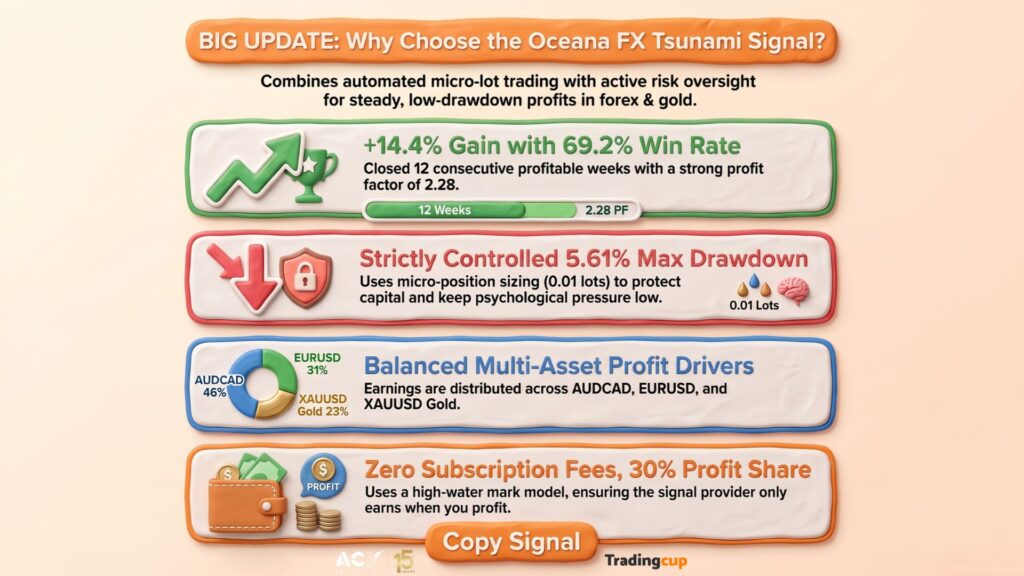
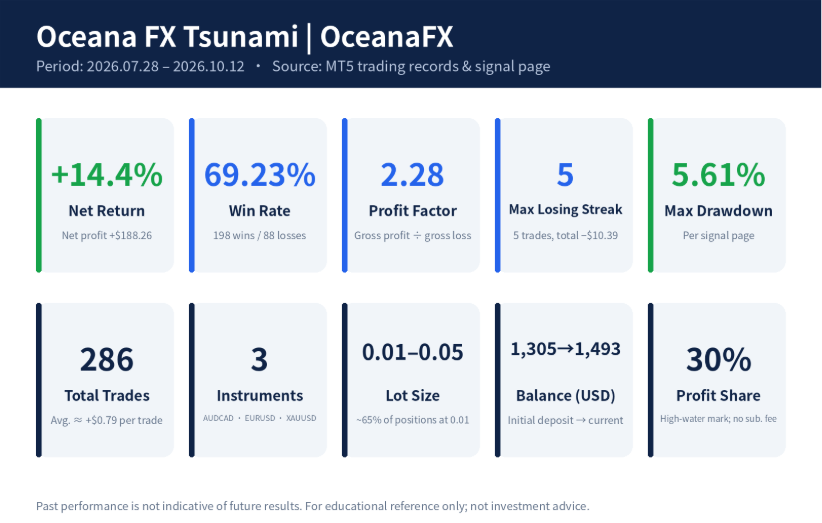
- Consistent Profits: Generated a +14.4% net return (account grew from $1,305 to $1,493.26) across 286 trades, with all 12 trading weeks closing in profit.
- High Win Rate & Edge: Achieved a 69.23% win rate and a 2.28 Profit Factor, with average gains ($2.02) and average losses ($2.00) almost equal.
- Controlled Drawdown & Fast Turnover: Maintained a low 5.61% max drawdown, with 77% of positions closing within 24 hours.
- No Fixed Subscription Fee: Operates on a 30% profit-sharing model under a high-water mark, aligning provider incentives with copy traders.
- Key Holding Risk: Relies on scale-ins without hard stop-losses, causing losing trades to be held significantly longer (~59 hours) than winning trades (~12.8 hours) while waiting for price reversion.
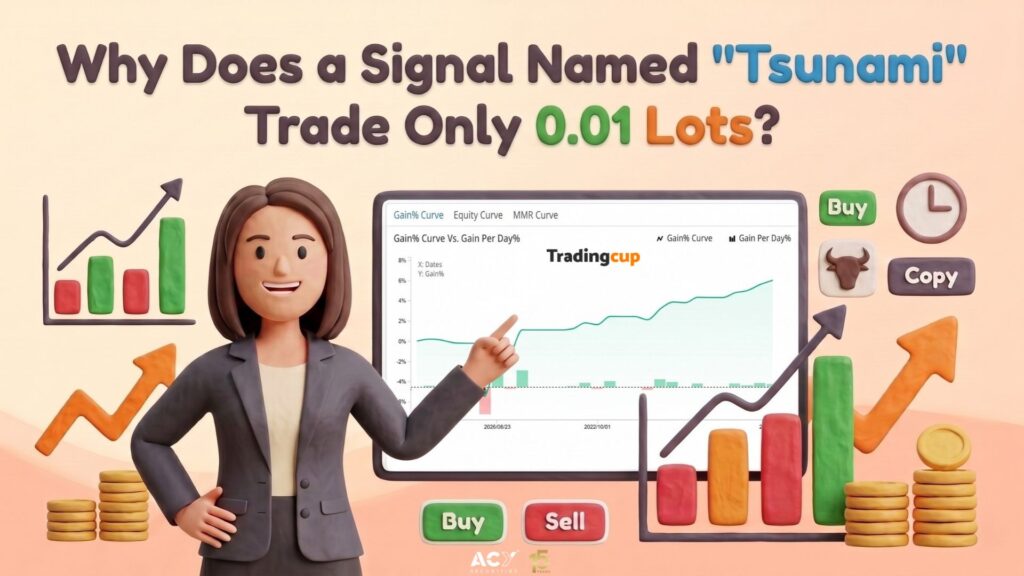
Mention a “tsunami” and most people picture towering waves and sudden impact. Yet on Tradingcup, there is a signal called “Oceana FX Tsunami“, provided by OceanaFX, that does the exact opposite: it trades three instruments — AUDCAD, EURUSD and XAUUSD — with a minimum single-trade size of just 0.01 lots, steadily lifting the account through one small profit after another.
This article walks through the signal’s approach, its five main strengths and the points copy traders should keep in mind, based on 286 closed trades over roughly 2.5 months.
I. Signal at a Glance
OceanaFX positions the signal as a fully automated algorithmic strategy with human risk oversight. For further verification, copy traders can also cross-check the track record of OceanaFX’s other signals on Myfxbook.
II. The Approach: Turning One Big Strike into Many Small Steps
Based on the trading records, the strategy rests on three simple habits:
- Small positions. About two-thirds of positions are only 0.01 lots, and the largest is just 0.05 lots.
- Scaling in. More than half of all entries are added when a position in the same instrument and direction is already open, building up layer by layer and lowering the average cost. The idea is similar to a grid and scale-in strategy, but the lot sizes stay very small.
- Both directions covered. On AUDCAD, long and short positions are often held at the same time, which helps offset errors in directional judgment.
III. Five Key Strengths
1. A Smoothly Rising Equity Curve
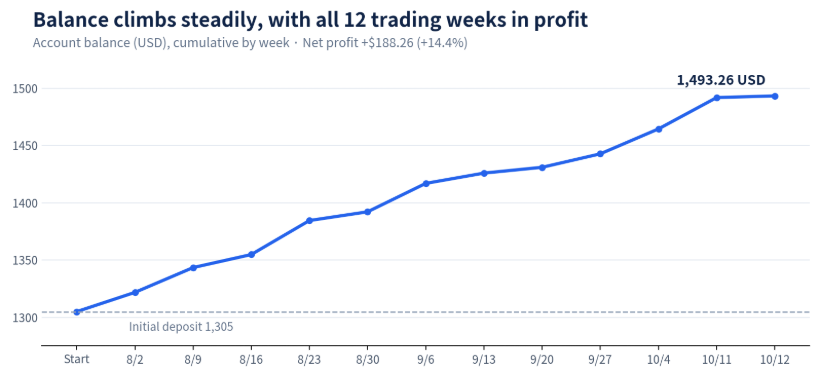
All 12 trading weeks in the period closed in profit, with the account balance rising from $1,305 to $1,493.26, a net profit of about +14.4%. For copy traders, a gradual, steady curve like this puts far less psychological pressure on them than sharp ups and downs.
2. Winning Through Frequency, Not One Big Bet
Of 286 trades, 198 were profitable, a win rate of 69.23%. The average profit ($2.02) and average loss ($2.00) are almost equal, so the high win rate translates directly into an edge, producing a profit factor of 2.28. The win rate is 72.46% on long trades and 64.71% on short trades, so both directions contribute.
3. Controlled Drawdown and Short Losing Streaks
According to the signal page, the maximum drawdown is 5.61%, which is manageable relative to a return of about +14.4% over roughly 2.5 months. The longest losing streak was only 5 trades, totaling $10.39. Capital usage is also light: at the time of the report, open positions used only $6.98 of margin, with a margin level of 21,405%.
4. Forex Plus Gold: All Three Instruments Contribute
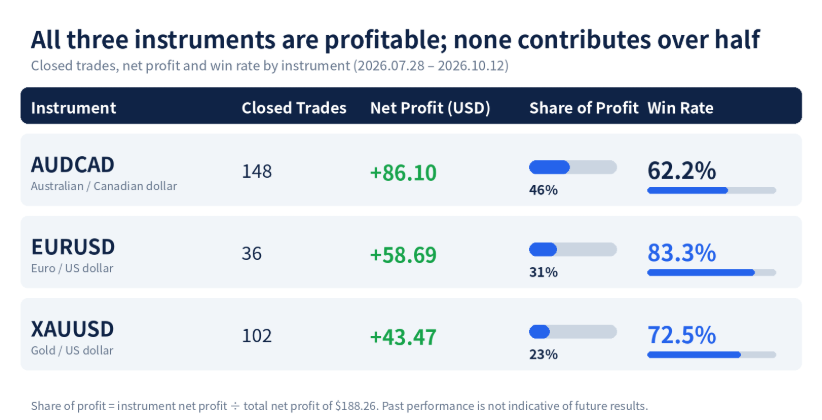
All three instruments are profitable. AUDCAD, EURUSD and XAUUSD contribute about 46%, 31% and 23% of the profit respectively, and none accounts for more than half. The style is short-term overall: around 37% of positions are closed within one hour and 77% within 24 hours, keeping capital turnover high.
5. A Fee Structure That Keeps Everyone on the Same Side
The signal charges no fixed subscription fee. OceanaFX takes a 30% profit share only on gains, with a high-water mark (nothing is charged until losses are recovered), so the signal provider’s interests are aligned with those of copy traders. When evaluating net returns, remember to factor this profit share in.
IV. Three Things to Keep in Mind
1. The Longer a Position Is Held, the More Likely It Becomes a Loser
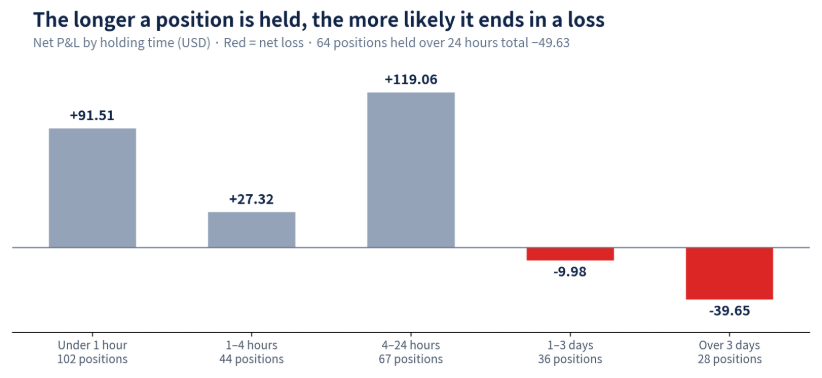
Winning trades are held for about 12.8 hours on average, while losing trades are held for almost 59 hours. The 64 positions held longer than 24 hours lost about $49.6 in total, and the largest losses came from AUDCAD positions held for 7–20 days. For scale-in strategies like this, a common practice is to avoid hard stop-losses and wait for price to revert. The upside is that positions are less likely to be shaken out by short-term swings; the cost is that during a sustained one-way trend, floating losses can linger for a long time, so copy traders should be mentally prepared.
2. A Short Sample Period and Aggressive Positioning
The data covers only about 2.5 months and has not yet gone through a full market cycle. OceanaFX positions this signal as an aggressive strategy suited to experienced investors; the currently low drawdown rests on small position sizes, and volatility will grow if position sizes are increased.
3. Drawdown Is Not a Ceiling
5.61% is the maximum drawdown over the reporting period. In sharp market moves, or when long-held positions lose at the same time, the drawdown could exceed this figure.
V. Who Is This Signal For?
It suits copy traders who prefer small position sizes, want a smoother equity curve and can tolerate temporary floating losses on individual positions. Start with a small amount of capital and keep monitoring how long-held positions behave in one-way markets before deciding whether to increase your allocation.
Looking for the Best Copy Trading Strategy?
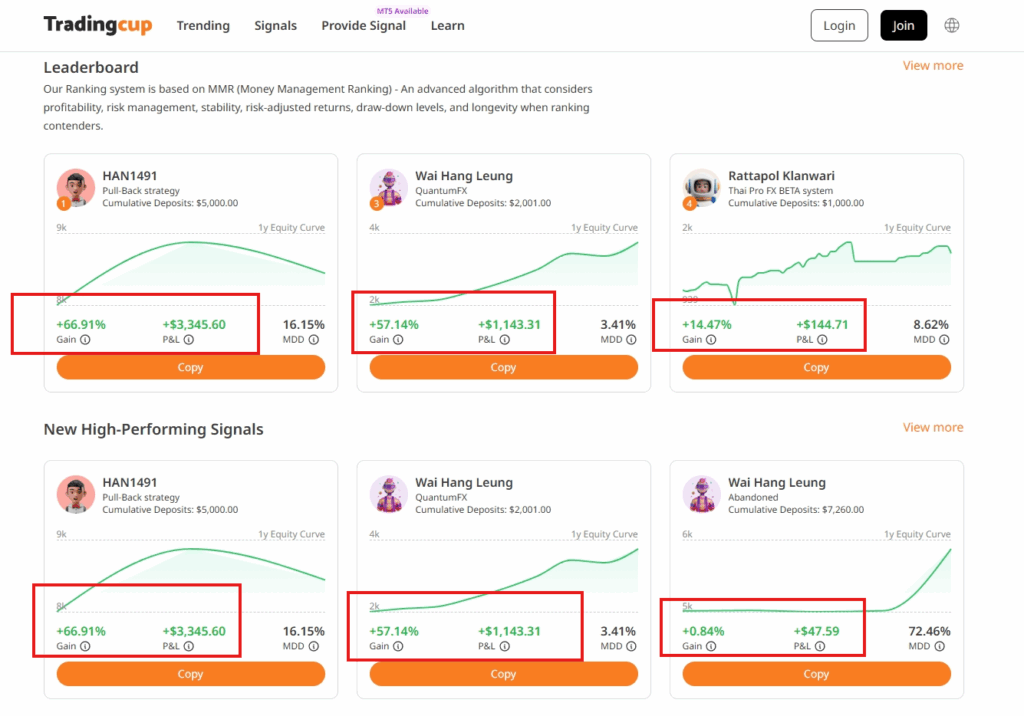
We’ve compiled a leaderboard of the most outstanding traders with excellent drawdown control and clear trading styles. This way, you’ll never feel lost when choosing who to follow and won’t blindly chase trends. Click to view the latest trader rankings and find out who is truly worth copying! Choose the right person, copy the right strategy, and from today, let copy trading truly create value for you.
Bonus Guide
What Makes an Effective Trading Portfolio?
- Diversification: Spread funds across various asset types (e.g., stocks, bonds, real estate, cash, precious metals) and industries/regions to reduce exposure to single-market volatility.
- Asset Allocation: Tailor allocations based on your risk tolerance, goals, and time horizon. Conservative portfolios emphasize fixed income, while aggressive ones lean into equities.
- Risk-Reward Balance: Each asset has different risk/return profiles. Ensure your portfolio avoids excessive exposure to high-risk or low-return assets.
- Low Correlation: Combine assets with correlations below 0.3 to enhance stability and provide a cushioning effect during market swings.
- Dynamic Rebalancing: Review and adjust your portfolio regularly as markets or personal goals change to stay aligned with your risk-return expectations.
- Clear Objectives: Define your financial goals (retirement, housing, education) before designing your strategy and time horizon.
- Discipline & Logic: Stick to your trading plan without emotional decision-making. Regularly reassess assumptions and market conditions.
(Disclaimer: This article is for informational and educational purposes only. It should not be considered financial advice. Always conduct your own research and consult with a qualified financial advisor before making any trading decisions.
For more detailed insights on developing daily trading routines, risk management, and effective position sizing strategies, explore additional articles on Trading Cup. Our trading experts at ACY and FinLogix are also great resources to guide your journey towards trading excellence.

Discover Our Best Trading Signals
At Tradingcup, you can browse through a selection of signals and review past performance before you decide to copy.
Become A Signal Provider
Share your expertise and become a signal provider so other traders can copy your trades.
Stay tuned to our blog for more trader spotlights and leaderboard updates.
Trading involves risks.
Visit the Tradingcup blog through the link below for more updates: https://www.tradingcup.com/learnBest blogs top 8 code to use if needed.
Related Copy Trading blogs:
- Understanding Market Liquidations: Liquidity Sweeps and Runs Explained
- 7 Essential Daily Habits of Successful Traders to Outperform Their Peers
- 10 Strategies You Can Copy off Our Best Copy Traders
- 5 Strategies Every Trader Can Master To Trade Better In A Trading Contest
- 2026 Copy Trading Scams Exposed: How to Spot Fraud
- A Swing Trading Strategy with an 83 Percent Win Rate and Low Drawdowns
- Forex Martingale Strategies Explained, The Good, The Bad and The Ugly
- Pyramiding Trading Tutorial – Pros & Cons & How to Use It